
Executive Summary: Blaming an idea for the ineptitude of or corruption by its enactors is not helpful. Grievances blamed on "capitalism" stem from individuals who break basic standards of integrity: the equivalent of blaming cycling for doping rather than holding cheaters accountable. Capitalism is a competitive sport where capital flows to the most efficient value creators and away from those who do not create intrinsic value. Money is simply meant to be a scoreboard. Creating excess money decoupled from value is like handing out counterfeit trophies. Every participant faces a fundamental choice: do we compete through value creation, or do we compete through exploitation?
I have been rediscovering how to frame what “good” looks like for one of the most critical institutions in our lives: companies. To understand how to build and evaluate them, we have to start by exploring the overarching theme of the essence of capitalism, without which we cannot align on the underlying operational details.
What comes to your mind when I say "Tour de France"? I anticipate two types of reactions. Some might say that it is the world’s most elite cycling tournament. Others might say it is scandalous due to the history of doping among elite cycling athletes.
Neither group is wrong. But it is important for us to delineate what each group is really talking about. The first group is talking about the essence and intention of the Tour de France and the vast possibility behind it. The second group is thinking about unethical individuals, corrupt groups, and their behaviors in and around the event.
In the case of cycling, it is fine for some of us to ignore this distinction or avoid watching the Tour altogether. But that luxury does not exist when it comes to business. The air we breathe and the water we drink, not to mention the infrastructure and products around us, are directly shaped by how we buy, invest, and work.
It is true that an amazing actor can take on a bad script and end up in a terrible movie. But the reverse is equally true: a great story or book can be handed to a lousy writer, an undisciplined director, and incompetent actors to create an unwatchable film. If we were a writer, director, or actor, what would be the best use of our energy? Should we preemptively assume others will not pull their weight, or should we focus on putting our best work forward?
Blaming an idea for the ineptitude of or corruption by its enactors is not helpful.
Consider three common conversations:
This is a pervasive reaction across our ecosystem. Whether it is Hollywood, politicians, managers, individual contributors, or consumers, most people blame "capitalism" or "corporations" for their troubles.
Yet these grievances stem from the deliberate or negligent actions of individuals who break basic standards of integrity. Blaming the economic system for their conduct is the equivalent of blaming the sport of cycling for doping and match-fixing, rather than holding the cheaters accountable.
Would any of us accept this argument: "I grew up in a dysfunctional family; therefore, the family as an institution is inherently bad"?
No. Someone who feels that way grew up around individuals who failed to build a healthy home. Companies are no different. In each case, people blame the overarching concept for the choices of bad or incompetent actors.
No top-tier athlete starts playing a sport purely for trophies. They play because they love competing and relish the day-to-day discipline of the craft. In pure athletic competition, it is difficult to fake capability because the rules of engagement are clear and winning is unambiguous. Even an athlete using performance-enhancing drugs must possess immense baseline talent to compete at an elite level.
In the sport of capitalism, however, the rules of engagement and the measurement of victory are often far squishier. That ambiguity allows surface perception to overshadow genuine performance.
A common misconception is that money is the foundation of capitalism. It is not, and that misunderstanding distorts the entire economic model.
Money, whether paper currency, gold, silver, or digital tokens, exists for one purpose: to act as an objective scoreboard. We could use anything that cannot be forged without collective agreement as money.
Money is simply a token of exchange.
The traditional barter system was an effective, foundational form of capitalism: you had to be good at raising chickens, growing crops, or treating illnesses, and you traded those specific goods and services for what others produced. We invented money to resolve the logistical friction of trading a chicken to a doctor who might not need poultry that week. Money allows us to transact value without executing a cumbersome physical swap of goods and services.
Trading one form of currency for another simply to generate paper gains without creating underlying utility is a distortion of the economic scoreboard. Money was designed to flow in the opposite direction of real value. Value creation is the sole purpose of capitalism. Nothing more, nothing less.
Value is the utility that solves a real-world problem.
That problem can relate to any dimension of the human experience: physical, operational, emotional, or psychological. In a complex economy, value creation often travels through an extended operational chain before it resolves a tangible human need.
Talking about value is not the same as creating value. Engaging in activities that extract capital without advancing the delivery of real utility does not help an economy. It is rent-seeking: extracting money without solving a real-world problem.
Capitalism's historic and mainstream definition is lazy. The core historic definition of capitalism revolves around claiming that capital injected into a private enterprise is better than giving capital to government. But what exactly is a private enterprise? Is a publicly traded company that is also on an index where everybody in the country has their retirement money considered private? If those same private enterprises take government subsidies or benefit from government protectionism, is that a private enterprise? Viewing capitalism through the lens of such specific-sounding words with absolutely no definition only confuses its real intent.
"Private" entities can use capital as poorly as the most inefficient "governments." Well-run "governments" could use capital as well as the most efficient "private" entities. So, here is my definition of capitalism:
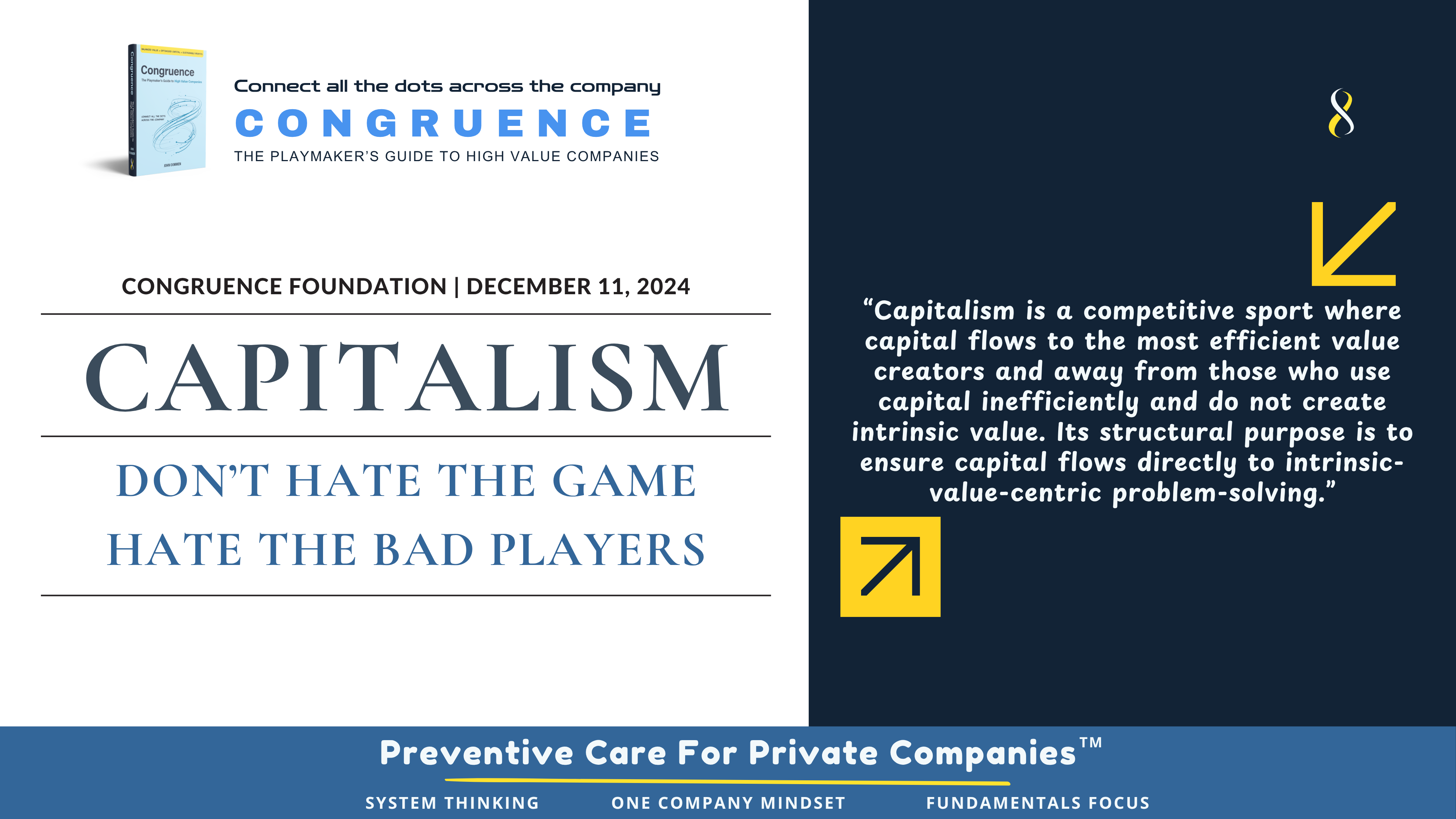
“Capitalism is a competitive sport where capital flows to the most efficient value creators and away from those who use capital inefficiently and do not create intrinsic value. Its structural purpose is to ensure capital flows directly to intrinsic-value-centric problem-solving.”
It was never intended to reward the manufacture of illusions that distort fair exchange. Bad actors attempt to game the equation, extracting more cash than the value they contribute. Creating excess money decoupled from underlying value is the economic equivalent of handing out counterfeit trophies in sports. It dilutes the efforts of genuine value creators.
Many people claim to dislike competition, but that view ignores reality. Competition is an inescapable law of nature. Watching animals in the wild reveals competition in its purest, unsentimental form. The same competitive dynamics govern cellular biology, physics, and chemistry. Just as energy can neither be created nor destroyed, competition persists across natural environments and human endeavors alike.
Arguments against competition are often leveraged to manipulate populations. Economic models like communism and state socialism distort nature by concentrating authority among an elite few who convince the rest of the population not to compete.
While the competitive drive is innate to human nature, so is opportunism. As the problems we solve become more complex, we must demand greater integrity and sophistication in the rules governing our trade. Without robust rules, bad behavior will continually degrade fair exchange.
Every participant faces a fundamental choice: Do we compete through value creation, or do we compete through exploitation?
The dilemma facing anyone participating in an imperfect system is straightforward: Do we take shortcuts to win, or do we maintain the discipline to build real capability, even when that path is longer and harder?
The answer is personal, but its impact is collective. How we treat an organization's capital and customers directly reflects who we are:
Doping in sports is never isolated to the athlete who takes the compound; everyone across the support team who turns a blind eye is complicit. In a company, silent complicity produces the exact same decay.
Rather than viewing company dynamics solely through the lens of personal wins and losses, we must evaluate the enterprise as a total ecosystem: customers, investors, employees, suppliers, and communities. How do our daily decisions affect the various stakeholders of the companies we buy from, supply, manage, and invest in?
If we prioritize short-term shortcuts and personal vanity over real value creation, we tarnish the competitiveness of our greatest sport: capitalism.

John Oommen is an electrical engineer turned company-level evolution architect who partners with private company investors and middle-market CEOs to mature and transform portfolio companies. He is the author of Congruence: The Playmaker's Guide to High Value Companies, creator of the underlying proprietary Congruence mindset, model, and method, and pioneer of the Playmaker Capability, which is a must-have value injection mechanism that dovetails purpose, strategy, and operations.
Over more than two decades, John has led company-level transformations, M&A integrations, and operational turnarounds across dozens of mid-market, VC and PE-backed, and Fortune 100 companies, including General Electric, Accenture, Blue Ridge Partners, and Capital One, as well as enterprise clients like Emerson, Ferguson, Cox, Avaya, and Nortek, alongside numerous mid-market companies. He specializes in addressing business-to-business market problems spanning industrial manufacturing, distribution, technology, and tech-enabled services. John holds an MBA from Northwestern University’s Kellogg School of Management, is a certified Six Sigma Black Belt, and is based in Chicago.