
Executive Summary: Methodically maximizing and maintaining alignment between purpose, strategy, and operations is the only path to optimizing value exchange between company stakeholders. When investments are short-term, the profit motive alone isn’t a helpful guide. A company’s strategy articulates who it serves, what it offers, and how it delivers. Purpose serves as the necessary anchor for choosing the right strategy.
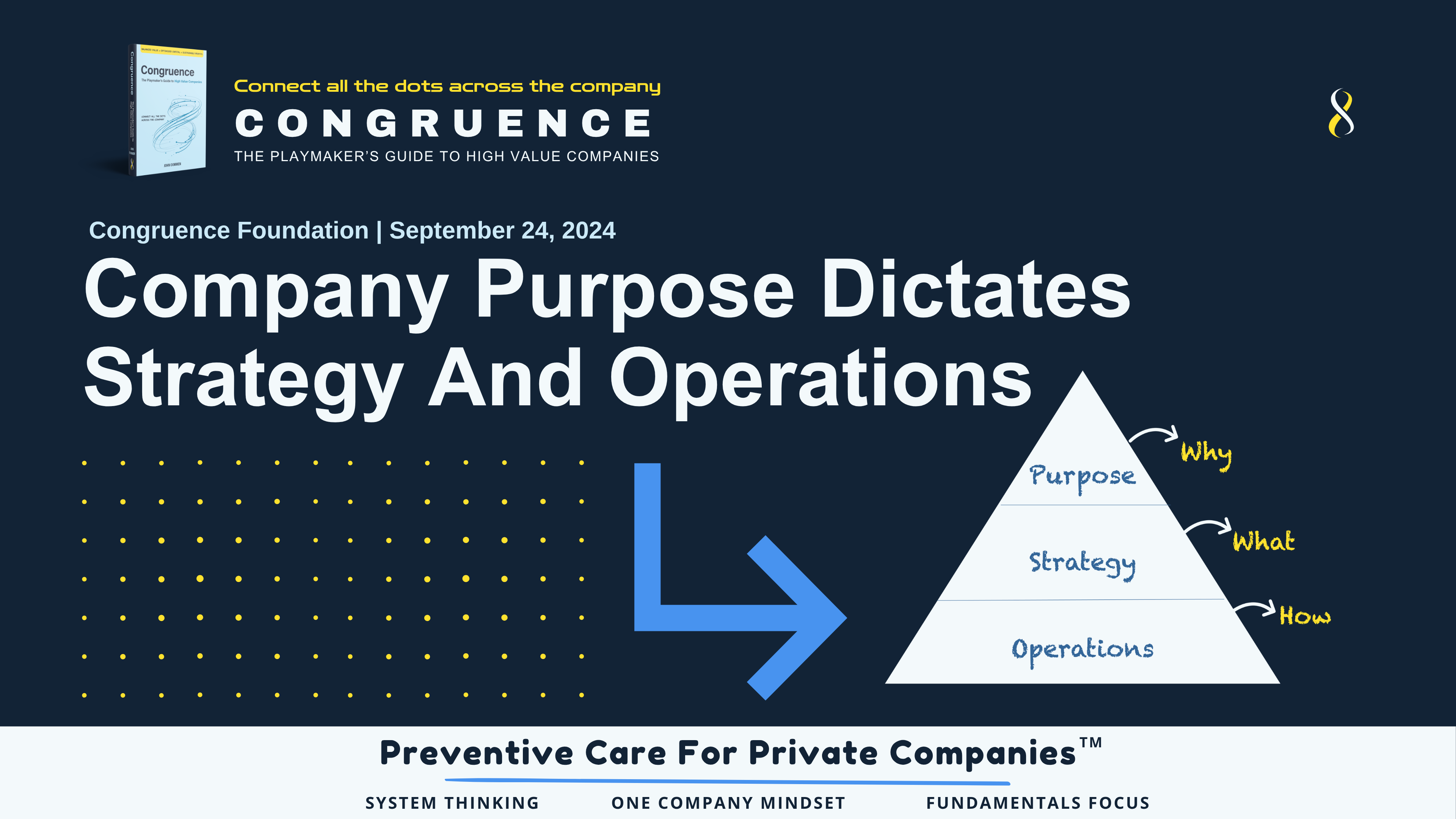
Company purpose dictates its strategy and operations. Don’t dismiss the word as too soft or reduce it to “mission” or “vision.”
I like to ask myself the tough questions I pose to others. I asked myself the all-important question about purpose: “Why am I in business?”
I shared a LinkedIn post with some thoughts on why I do what I do. One part of that post summarizes lessons I’ve learned over the past twenty years and shapes the value I aim to create:
“Every company has incongruences between its purpose, strategy, and operations, which directly cause value creation and delivery challenges, capital inefficiency, and unsustainability. Methodically maximizing and maintaining alignment between purpose, strategy, and operations is the only path to optimizing value exchange between company stakeholders.”
One interesting comment I received came from the head of Strategy & Corporate Development at a public company:
“Can you explain how purpose would vary among companies? Given that Milton Friedman's approach [maximizing profits for shareholders] has stood the test of time for decades, shouldn’t the ultimate purpose be the same for most companies?”
I loved this question; it led to a deeper offline conversation.
My answer is “no.” Beyond all rational reasons, I know this because I’m a small business owner. My motivation isn’t simply mirroring others in the market and short-term profit maximization.
I created Acumes as a market disruption outfit that brings original and value-centric impact to private companies while staying at the forefront of the market. As an engineer, the value I bring to companies is transformational, setting it apart from typical staff augmentation that lacks deep problem-solving or unique intellectual property. Being just a replacement body isn’t the value I want to provide, even if it means turning down potential clients looking for staff augmentation. Is there a possibility that I won’t maximize profits? Yes, that is a risk I want to take because I want to provide a specific service.
The purpose of my small business is unique compared to other “consulting firms.” So, let’s explore Friedman’s views a little more.
Milton Friedman is an American economist who has shaped the theoretical views of most modern capitalists. In his 1962 book Capitalism and Freedom, Friedman famously stated, “There is one and only one social responsibility of business: to use its resources and engage in activities designed to increase its profits so long as it stays within the rules of the game, which is to say, engages in open and free competition without deception or fraud.”
If you are unfamiliar with Friedman’s perspective, his 1970 New York Times essay offers a good summary.
I fully support the profit motive, and I obviously care about how much profit I generate today and will continue to make over time. However, I have come to realize that terms like “rules,” “open and free competition,” “deception,” and “fraud” have no practical consensus.
As practitioners, we must add more specifics to avoid interpretations leading us astray.
In the sixty years since Friedman’s book, a lot has changed.
First, the biggest shift is in a company’s 'why.' We used to run companies. Now, we primarily flip private companies, just like houses. Public company shares are traded in microseconds, and that changes everything. Which shareholders care about profits: the current ones or the future ones? Friedman doesn’t account for the frequent changing of company ownership.
Second, Friedman assumes that investors make independent decisions. In today’s fund-of-fund-of-funds era (pun intended), individuals do not choose investments. Massive funds expect returns based on everyone else’s expectations rather than on investor-specific risk appetite or intrinsic assessments of investments.
When investments are short-term, the profit motive alone isn’t a helpful guide.
A company’s strategy articulates who it serves, what it offers, and how it delivers. A few years ago, I realized that strategy cannot be chosen in isolation.
Any given company can have many permutations that could be its strategy.
Consider this: What’s the optimal design for a house party? It depends entirely on why we’re hosting the party. Purpose serves as the necessary anchor for choosing the right strategy.
Now, imagine two dry-cleaning businesses. One is run by a middle-aged couple with no intention of growing beyond inflation and plans to shut down when the owners, who are also the shareholders, retire.
The other is started by an entrepreneur who brings in several investors with the goal of quickly building a chain of dry-cleaning stores, intending to sell the chain in a few years. These are both dry-cleaning companies, but their makeup is driven entirely by their distinct purposes.
A company’s purpose is its 'why.' It dictates who is involved in the company: who invests, which employees or partners work there, whether it creates a massive shift in customer benefits or just a run-of-the-mill improvement.
Every company requires a unique purpose because the people in each company are unique.
The only alternative is to assume people are identical across companies, and therefore, every company shares the exact same purpose. If that were true, every company would be an undifferentiated commodity with no real reason to exist.
There are many questions to ask when framing a company’s purpose. Here are three high-level starters:
The more comfortable we are with writing down and sharing these answers with all stakeholders, the more balanced our purpose is likely to be. While there’s a lot more to consider when defining a company’s purpose, this is a good starting point.
Mergers and acquisitions (M&A) have a role to play when appropriate. No two companies are alike. No company is acquired because it excels at all three of these aspects:
So, which of these core parts of the company are we buying? Are we buying customers? The company’s offerings? Or how they operate in delivering that offering?
We should ideally be paying for those aspects that provide sustainable value. The same consideration applies if we want to exit by selling our company. Which of the who-what-how components creates value for the acquirer?
When it comes to pricing companies, I never advocate for multiple-based mathematics, where we simply multiply a company’s revenue or earnings by an arbitrary figure because that multiple is the prevailing trend.
So, why reduce a company to such a simplistic pricing scheme? Oversimplified multiple-based company pricing became prevalent because companies, especially mid-market ones, are bought and sold every few years and a “Run Mindset” is not in fashion. This is also not sustainable.
Traditionally, company buyers have focused on a single metric: the Internal Rate of Return (IRR). The IRR is the aspirational growth rate used in investment models to estimate how much an investment will grow until the money can be redeemed. For example, the IRR of putting all our money into a certificate of deposit (CD) is its interest rate.
IRR has been used by private equity, venture capital, and even individual buyers to justify why one investment is better than another. Unlike CDs, the problem with using IRR in buying companies is that it’s aspirational until the money is returned. When trying to raise money to buy a company, this aspirational nature creates a tendency to promise overly optimistic IRRs in pricing models.
An overly optimistic IRR creates several problems. First, it allows buyers to rationalize paying a higher price, based on the hope of making a lot of money when the company is sold five to seven years later. This is similar to overpaying for a house and then going underwater when trying to sell it.
Second, IRR is often chosen not based on the intrinsic value of the investment (in this case, a company), but due to peer pressure driven by conventional views of what an investment should yield. Using the house analogy, it's like house prices rising simply because others are overpaying for houses, which is a similarly irrational choice.
All of this has resulted in large portfolios of private companies that are fundamentally underwater. This dynamic has brought a different metric into the spotlight: Distributions to Paid-In Capital (DPI).
While I never advocate over-indexing on any one metric, I appreciate the reality around DPI. It’s a straightforward ratio: the total money distributed to investors divided by the total money taken from them. Aspirations don’t come into play. DPI only measures real money made by investors.
My suggestion to every owner is to go back to the basics. Companies make a sustainable and growing profit because they have a highly value-creating offering that is appreciated by customers who are willing to pay for it, and the company can deliver that value efficiently.
When companies make sustainable and growing profit, investors would consider it an attractive long-term asset to hold, especially in a world where exit opportunities of the easy-money era don’t exist. The DPI for those companies is attractive. So, the question for any company goes back to:
Why does the company exist, truly?

John Oommen is an electrical engineer turned company-level evolution architect who partners with private company investors and middle-market CEOs to mature and transform portfolio companies. He is the author of Congruence: The Playmaker's Guide to High Value Companies, creator of the underlying proprietary Congruence mindset, model, and method, and pioneer of the Playmaker Capability, which is a must-have value injection mechanism that dovetails purpose, strategy, and operations.
Over more than two decades, John has led company-level transformations, M&A integrations, and operational turnarounds across dozens of mid-market, VC and PE-backed, and Fortune 100 companies, including General Electric, Accenture, Blue Ridge Partners, and Capital One, as well as enterprise clients like Emerson, Ferguson, Cox, Avaya, and Nortek, alongside numerous mid-market companies. He specializes in addressing business-to-business market problems spanning industrial manufacturing, distribution, technology, and tech-enabled services. John holds an MBA from Northwestern University’s Kellogg School of Management, is a certified Six Sigma Black Belt, and is based in Chicago.