Executive Summary: We are currently navigating what I call The Productivity Crisis, driven by an addiction to easy money and growth-at-any-cost tactics that prioritize short-term, extrinsic motivations over intrinsic value. To recover, we must return to the fundamentals of capitalism by building Holistic Companies™. A Holistic Company™ maintains an equilibrium state that balances the incentives of all stakeholders (investors, customers, employees, partners, and society) and ensures true financial sustainability without relying on capital engineering. By focusing on sustainable business models rather than unsustainable scale, we can limit value-destroying and capital-wasting distractions and productively create sustainable value.
Suppose you are an athlete committed to training hard and improving your game. Would you prefer your sport to have well-laid-out rules and effective scoring or one where winners benefit from unsportsmanlike conduct and spurious scoring?
Why would almost every sector in the market slump when central banks raise interest rates by the tiniest amounts in real historical terms? Why do layoffs kick in immediately after the Federal Reserve indicates they will stop printing money and raise interest rates from zero, even though we have all agreed that easy money conditions are unsustainable for years? Why are market anchors talking about "buying the bottom" and asking "when will interest rates come back down?"
The objective answer is that we are addicted to easy wins enabled by unsustainable tactics. Companies that focus on extrinsic share prices and impractical feel-good themes rather than sustainable business models and intrinsic value creation are too common in our free-lunch ecosystem.
Any number divided by zero has the same result: infinity. When the basics of money become meaningless, all other measurements around money are also meaningless. Inflation is not rampant because of external scapegoats. Inflation is rampant worldwide because the growth-at-any-cost party required complimentary champagne to flow for too long. Now, the price of champagne is debased from reality.
Why is this a problem? When gravity is zero, it is hard to know which athletes have stronger legs because everyone is floating. Zero gravity in the form of easy money is a massive equalizer, but in the wrong sense. We reward entities created with a short-term agenda willing to sacrifice tangible customer value or capabilities necessary to scale. In a growth-at-any-cost environment, a well-run company focused on the basics to create customer value and building the required muscles to increase that value over time is at a much bigger disadvantage.
The specific area of concern is hard to pin down in our economic downturn because the issues are systemic. Every downturn has a name. I am going to call it The Productivity Crisis. Capitalism has gone off track because we have diluted the meaning and intention behind even the most basic ideas. The Productivity Crisis is a direct result of such disassociation from fundamentals. To rise from The Productivity Crisis, we must embrace the true essence of capitalism. It starts with building what I call Holistic Companies™.
To start down the path of addressing The Productivity Crisis, let us embrace two fundamental questions:
There are so many business books and articles out there. Most cover narrow elements of companies, leaving the rest conveniently unaddressed. Others glorify the protagonist and their war stories. There are many opinions on social networks about tactical activities around companies, which are essentially marketing those activities. Amid all this noise, we have lost track of what a "company" means.
References like "Corporate America" or "corporations" are infused with real or feigned anger and disgust. Politicians and pop intellectuals who benefit from creating angst to get votes and sell coaching programs originate some of these sentiments. Individuals who set up legal entities that promise value and future profits only to swiftly sell those entities to make a quick buck at the expense of prospective shareholders also damage the brand.
Early associations to the term company are the French word compagnie, which implies "large group of people," and the Latin word companio, which means "bread fellow." By the fourteenth century, we started using the word company for its present intention: "a number of persons united to perform or carry out anything jointly."
In Congruence: The Playmaker’s Guide to High Value Companies, I define a company as:
“A company is a relationship between people who have agreed on a mutually beneficial contract to conduct trade together. The people involved partake in this complex relationship to bring value to the collective and extract value that satisfies their incentives.”
Yes, it is simple. But simple can be tricky. This definition implies that we must consider all the people involved in an endeavor and their incentives. Discussing ourselves, our incentives, and complex paperwork that meets our selfish needs is effortless. This simple but hard-to-live-by essence of a company is precisely why conversations about companies devolve into chaotic bar brawls about trivial and polarizing topics. In our search for personal glory, we have lost sight of the forest for the trees. We do not refer to the word company as we intended to use it:
Let's use an analogy to internalize how to think about companies. Imagine a house. A customer rents or buys a house. A builder must think about that customer when they create housing options. Investors must consider the customer's desired lifestyle and affordability and the builder's skills when putting money in. All of them must consider the lives of others in the neighborhood. A company involves all such considerations around a single house.
But a house might sit in a larger compound with others constructed by the same builder and investors. This situation exists because investors and builders can make more money by putting several houses next to each other. Customers might get a marginal benefit from a shared swimming pool or a gymnasium. But it is suboptimal to lose sight of the critical fact that customers sleep, eat, and work in their houses.
We must focus on the house-company metaphor to return to relevant core concepts. We can attribute most confusing conversations around companies to disassociation from the most practical aspects of value creation, which revolve around a single house in this analogy.
I urge a much-needed reversal towards fundamentals around companies. By fundamentals, I do not mean free cash flow that financial minds get drawn towards, extrinsic market pricing that investors focus on, or themes that special interest groups talk about. By fundamentals, I mean all the people involved and their complex incentives, only some of which are about money. With this baseline definition, let's talk about holistic companies.
We consider Adam Smith, the father of modern economics. We can summarize his political economics theory as: "Every person, entity, and nation must do what is in their own best interest, and the overall outcomes will be the best."
In our increasingly short-term ecosystem, companies tend to operate within the Adam Smith model right now. Investors focus on their returns and don't care at whose expense. Employees ardently concentrate on maximizing their compensation and titles, regardless of qualifications or depth of experience. Consumers overspend based on unsustainable government incentives that confuse GDP figures with living standards. Consumers buy indulgently without effective price-to-value and affordability considerations, which translates to inflation.
But there is a problem. The market economy is approaching a breaking point with unserviceable debt levels and systemically low productivity growth. Something must give.
John Nash revised Adam Smith. He framed that the best outcomes happen when each player in the ecosystem considers the downside and upside of all the other players and then makes a choice that will likely benefit them and everyone else.
The most significant difference between the two mindsets is the importance of time and information. Adam Smith's everyone-for-themselves mindset assumes that no one knows anyone else's hidden motivations and actions, nor will they change their mind over time when they learn more information. But that is not reality.
Every relationship has an equilibrium state based on how value is created and consumed by each party involved. On the positive end, the equilibrium can be a happy relationship where every party is content. On the opposing end, the equilibrium is a relationship dissolution because the parties cannot agree on a mutually beneficial set of criteria. This equilibrium state in any multi-party relationship is called Nash Equilibrium.
This concept applies to any situation involving multiple people or groups, each with unique incentives. Unless an ecosystem balances the incentives of every person or group of similar people involved, the ecosystem breaks down, and the collective no longer exists. Imagine a marriage where two people have different interpretations of fidelity. When this difference becomes apparent, the marriage breaks down.
In the context of a company, any stakeholder group or specific individual can only unfairly benefit from others in the ecosystem for a short period before others recognize the imbalance. Once the imbalance is identified, all the prior agreements to collaborate as a company fail.
I have searched for a formula to build and manage "good" companies for two decades. I realized "good" companies create an ecosystem where the Nash Equilibrium is where all stakeholders' incentives are considered, communicated, and fulfilled.
In this definition, we must not confuse or generalize three crucial terms:
The underlying motivations of each stakeholder group, not absolute dollar amounts or formulaic metrics. Customers have a host of considerations when purchasing beyond the immediate cost of a transaction. Employees consider factors like career growth, stability, flexibility, and societal status beyond salaries and bonuses. Investment professionals cannot only think about the rate of return for a single deal; they need to consider the motivations of those whose money they invest and other investment options.
Balancing the incentives of all stakeholders does not imply equality. In this context, balance means effective communication of each party's incentive and informed weighting of the value created by each stakeholder.
Put aside stereotypes about large and stable companies or red-tape, slow-moving institutions. Whether it is physics, chemistry, or strategy, equilibrium is the most likely state of existence given the choices at hand. Consider it as the realistic modus operandi over time given the current design of the overall company.
Here is an assessment question for the first condition of a holistic company:
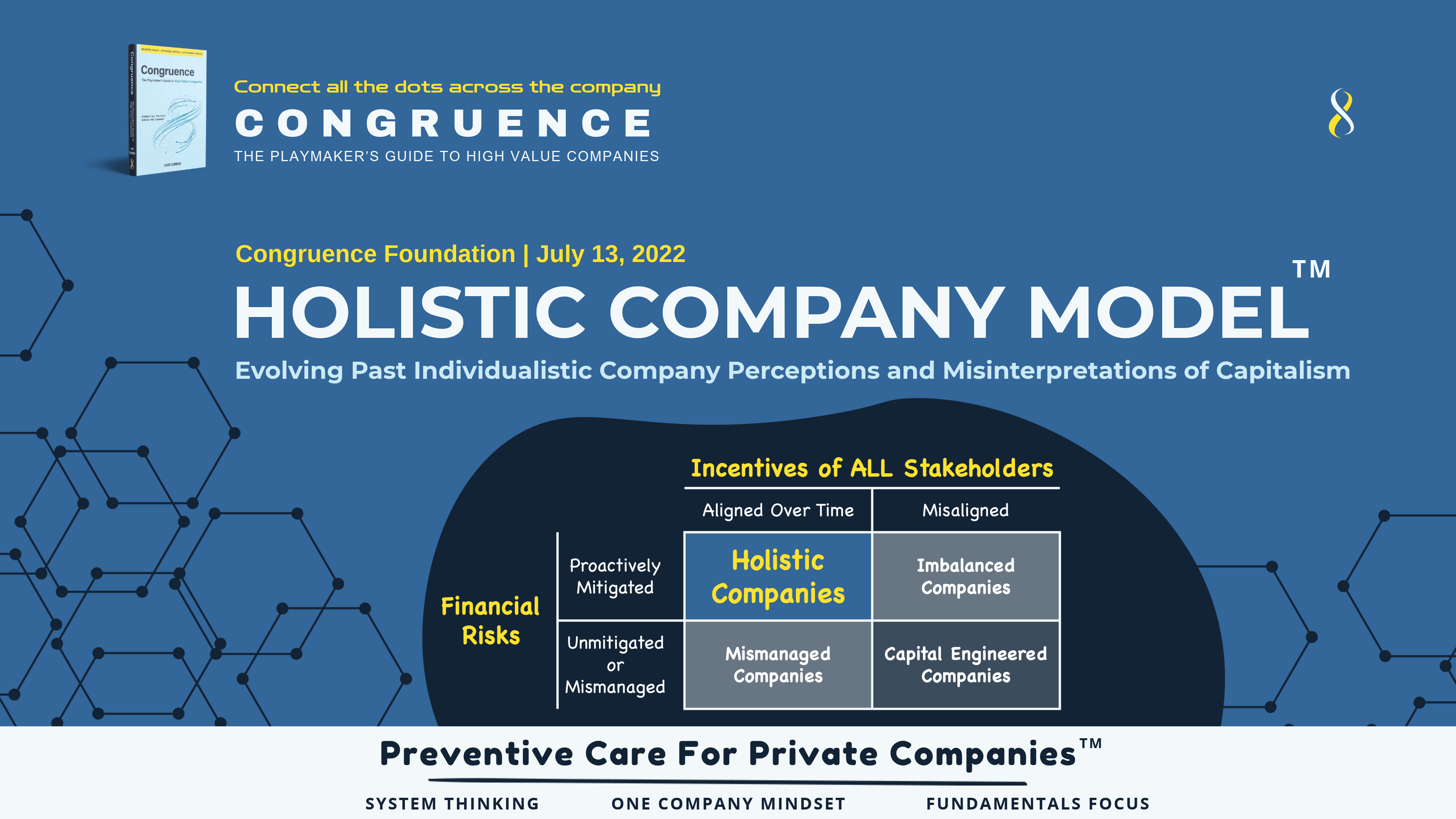
Does the ecosystem that forms the company balance the incentives of all stakeholders: investors, customers, employees, partners, and society, in equilibrium?
The incentives of stakeholders are ever-evolving as the world changes. So, balancing those incentives will require the company to evolve to keep up. To be clear, equilibrium here does not imply stability or low growth. A plumbing outfit owned and operated by two siblings can easily balance the incentives of all stakeholders. So can a startup with a few early investors, founders, employees, and customers where everyone knows the game at hand: a risky one with a nascent offering.
The balancing act becomes more complex as the size and range of stakeholder incentives increase. This increasing complexity is why building holistic companies is increasingly important. Companies are increasingly sophisticated arrangements, and the incentives of each stakeholder have deeper layers and multiple dimensions.
In today's complex world, staying away from financial sophistication is impossible. Ownership structures and investment vehicles are becoming increasingly complex. Buying and selling of companies happen far more often than it should. In short, there are many ways to keep a company afloat for a significant period through funky financial arrangements that can fall apart with a single trigger event.
Holistic companies are not financially stretched to a point where the entity is a ticking financial bomb. Financial stability doesn't mean we refrain from risk; there is no positive return without risk. But if the entire business model is a massive gamble that all stakeholders don't understand, balancing all stakeholders' incentives is a short-term illusion.
First, a company must be able to pay all its bills without perpetually taking on new money. In other words, companies must be profitable or at least break even. Otherwise, they are expensive hobbies. The pattern of operating in perpetual unprofitability became a fashion during the easy money era. It will pass once we turn off the money tap.
Second, borrowing money is a necessity in today's business environment. But taking on too much debt leaves the collective at risk when the company faces short-term headwinds. Debt collectors can call in what they are owed and disrupt the balance of a company's ecosystem overnight. The company's debt-level choices sit with a few senior employees, and their decisions and actions affect the entire ecosystem. Holistic companies manage their debt levels and related covenants by balancing the risk profiles of all stakeholders.
Third, holistic companies avoid counterparty risk by building a business model that relies on other holistic companies. Doing significant amounts of business with structurally unsound customers with unjustified incentives or signing agreements with counterparties that are Hail Mary endeavors puts our institution at risk. Such counterparty risk is financial unsustainability. It likely exists because we didn't find sustainable options for customers or partners.
Fourth, right and wrong get muddy quickly as an organization grows. No one starts with evil intentions, yet we end up with an opioid crisis, harmful fertilizer or talcum powder lawsuits, or predatory lending sanctions. Such events begin with setting and chasing unrealistic sales targets or cutting too much cost. Holistic companies limit financial risk from unrealistic incentives and operational goals that predictably lead to unethical behaviors over time.
Here is an assessment question for the second condition of a holistic company:
Is the company financially sustainable for a period that all stakeholders align on, considering cash flow, debt, counterparty, and adverse behavior risks?
After arriving at these two conditions, I started calling such sustainably profitable companies that balance the incentives of all stakeholders holistic companies. Our collective resources are best used to build and maintain them. In Congruence: The Playmaker's Guide to High Value Companies, I define that:
“Holistic companies maintain an equilibrium between the incentives of all stakeholders – customers, investors, employees, partners, and society.”
The true essence of capitalism is intended to be a competitive sport with rules of engagement. We must be disciplined and objective enough to transparently balance the needs of all company stakeholders.
This might seem obvious, but it is not. Please discuss with a friend or colleague and assess how much each of us digs our heels in and intentionally or unintentionally directs energy to personal short-term benefit. Look at some actual trends. Most LinkedIn employee posts these days focus on the self and our own stakeholder groups and sub-groups within. It is nice to advocate for our needs when we firmly fit into a group, but it is also an us-versus-others attitude that only results in unsustainable, capital-engineered companies.
What if everyone operates under a me-first and my-stakeholder-group-is-most-important mindset? Do we want to go into a war of attrition with every other stakeholder group? Adam Smith required revision because the outcomes of such games are usually mutually assured destruction.
The investor-first mindset does not work for the rest of the ecosystem either. I published some figures about our recent growth-at-any-cost era. Employees, customers, partners, and even society, in the form of public shareholders, lost to enable a victory for creators and private shareholders of rapid-scaled companies.
Beyond a few people doing business together, building holistic companies is extremely hard because it requires solving a five-dimensional problem that understands, evaluates, and balances the incentives of customers, investors, employees, partners, and society. This difficulty is precisely why we default to creating short-term, self-serving outfits.
Characteristically, the Holistic Company Model™ has no successes or failures. We always frame success and failures from the vantage point of one person or a similar group of stakeholders. In so-called successful companies, there are plenty of stakeholders that are losers.
Conversely, many unknown institutions satisfy the holistic company model. Winding down an early-stage startup because the market validation demonstrated a lack of viability is not a failure. It's a compelling market testing of a solution to a potential problem.
By extension, a holistic company does not have to operate in perpetuity. A dry-cleaning store run by a middle-aged couple as a source of cash flow is a holistic company as long as its operations serve its customers well without harming anyone else. The owners are the investors. It is not a failure if they discontinue operations at their desired retirement age. It is a successful endeavor that provided cash flow for the owners and employees and created value for customers throughout its existence.
Conversely, imagine a large bank formed by investors happy with skyrocketing stock prices based on a story about long-term prospects. It may have high-risk customers satisfied to get cheap loans and pleased depositors who the bank promised unrealistic interest rates for deposits. Yes, such an entity is bigger and growing. The bosses get paid in tens of millions. But it isn't a holistic company if the bank's operating model predictably runs into trouble and the rest of society must bail out stakeholders that previously benefited. Its equilibrium is an imbalanced relationship with the rest of society. The punchline is that scale or growth rate does not characterize holistic companies.
Companies that are not holistic will collapse in a reasonable period, leaving some stakeholders holding the bag. They benefit a subset of stakeholders for a certain period at the expense of the rest until time and information transparency trigger an equilibrium that is a breakup.
Take any company that collapsed unintentionally and test for our two conditions for holistic companies. The importance of holistic companies will become evident through such a thought exercise.
Capitalism is not going away, and we will always have companies. We must prioritize balance, value, reasonable incentives, and transparency of those motivations and limit the capital engineering of companies. Holistic companies accomplish all these needs and allow us to focus on productively creating value and limiting value-destroying distractions and activities.

John Oommen is an electrical engineer turned company-level evolution architect who partners with private company investors and middle-market CEOs to mature and transform portfolio companies. He is the author of Congruence: The Playmaker's Guide to High Value Companies, creator of the underlying proprietary Congruence mindset, model, and method, and pioneer of the Playmaker Capability, which is a must-have value injection mechanism that dovetails purpose, strategy, and operations.
Over more than two decades, John has led company-level transformations, M&A integrations, and operational turnarounds across dozens of mid-market, VC and PE-backed, and Fortune 100 companies, including General Electric, Accenture, Blue Ridge Partners, and Capital One, as well as enterprise clients like Emerson, Ferguson, Cox, Avaya, and Nortek, alongside numerous mid-market companies. He specializes in addressing business-to-business market problems spanning industrial manufacturing, distribution, technology, and tech-enabled services. John holds an MBA from Northwestern University’s Kellogg School of Management, is a certified Six Sigma Black Belt, and is based in Chicago.