Executive Summary: The sustainability of a recurring revenue model is predicated on true customer stickiness, yet companies routinely mistake short-term deterrents for long-term value creation. Contractual barriers and personal relationships are non-value centric impediments that rarely prevent customer churn when dissatisfaction sets in. Switching costs merely buy time, and periodic, non-recurring value delivery tempts customers to cancel once the initial need is met. True stickiness requires moving beyond deterrents to deliver an ongoing operational injection of value.
Pricing models that enable recurring revenue are not new. Even traditional sectors like commodities have the concept of a blanket purchase order, where a contract allows us to buy the same volume at the same price until the contract expires. But in such traditional settings, we always measure those companies based on their profit, not revenue.
It started with Software-as-a-Service pricing models offered by companies like Salesforce, which soon caught on and spread like wildfire. Every company has the incentive to use a recurring revenue pricing model because it limits entry barriers for customers and provides companies with continuous cash flow, which creates significant conveniences around internal operations. Now, any offering can be sold with an as-a-service tag. Examples include Service-as-a-Service or Business-Process-as-a-Service models.
Companies have a lot more leeway in terms of profits if they show strong recurring revenue growth. This is the predominant difference between the new-age as-a-service model and traditional long-term customer relationships.
Growing revenue at a remarkable rate implies we must keep the customers we already have. This is where the recurring portion comes from. The effectiveness with which we can retain existing customers is often referred to as “stickiness.” The sustainability of a modern-day high-growth company is predicated on creating stickiness with customers. This part is obvious, but the effectiveness with which companies go about doing it requires a deeper exploration to understand true sustainability.
Where do efforts to create stickiness go wrong?
A company’s efforts to create stickiness go wrong when too much time and effort is invested in short-term tactics as opposed to long-term value creation.
Imagine trying to maintain a relationship with a significant other. We can try to hold it together by buying our partner nice things. We could even have a logistical constraint, like a contract to share a living space. But anyone who has been in a relationship knows that these are just emotionally and monetarily taxing efforts that eventually lead to the same place: a breakup. Alternatively, we could change our behaviors, go to therapy, or take several other intrinsically value-creating actions that make the relationship a more effective one. In a relationship setting, this all seems obvious.
In an as-a-service setting, short-term tactical actions are intended to protect our company, not create value for customers. These are relatively similar activities that every company can apply, but they will not lead to differentiation. Conversely, creating long-term value focuses on the customer, which takes patience and discipline. We must look across four distinct tiers of retention activities, prioritizing our attention and capital on the highest-order value creators.
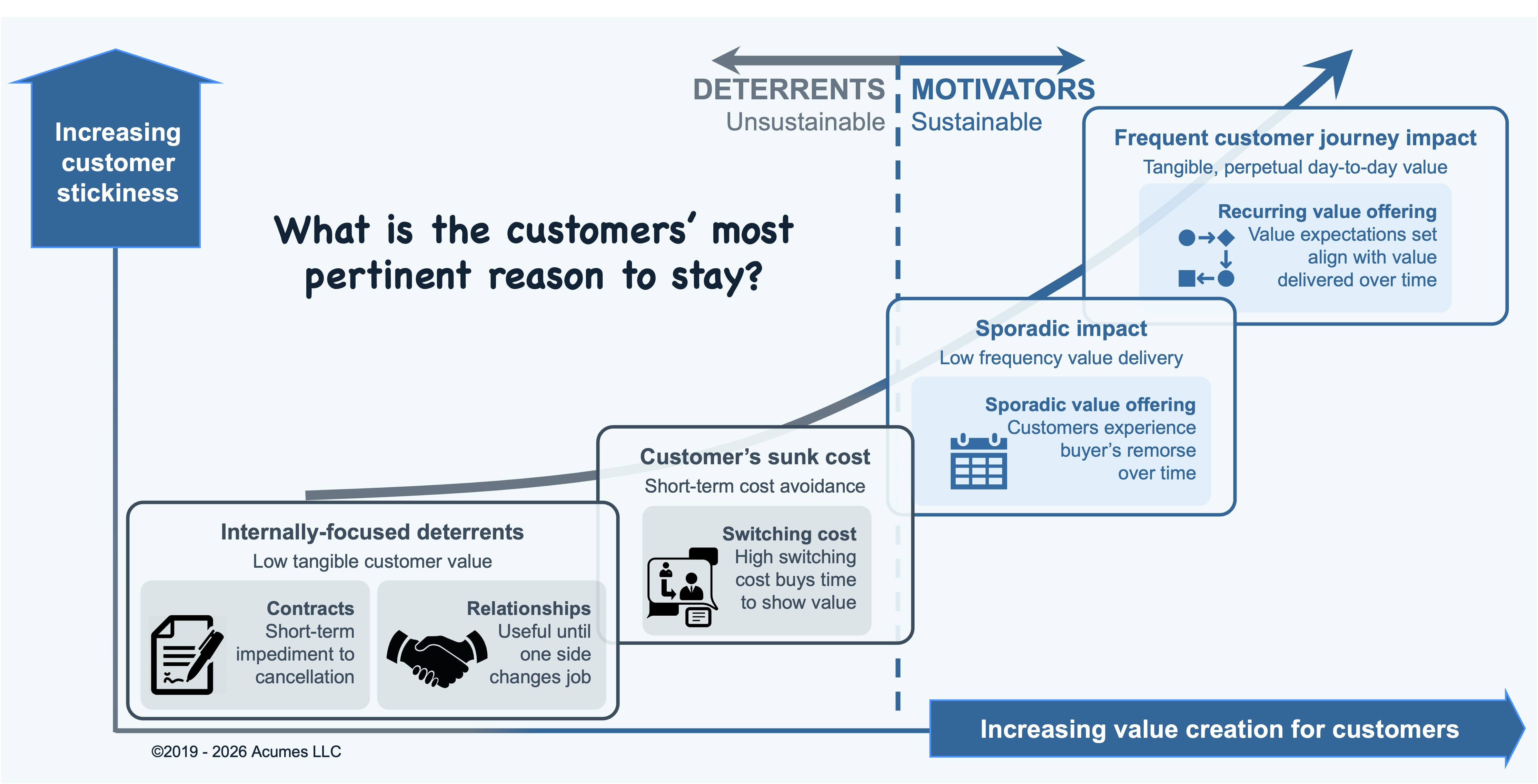
Impediments such as contracts and relationships have a limited impact on stickiness.
A contract almost never holds up if the customer is not happy. I cannot tell you how many companies I have seen try to use a contract as the silver bullet to create stickiness. But a legal path is not in anyone’s best interest. A contract can protect our company against aspects like misuse of our offerings. A contract will give the customer some inertia to stay on the first or second time they feel dissatisfaction, but not much beyond that. It can also allow us to get paid for another period or two because we included a cancellation timeframe in a contract.
But this deterrent will not last long. If customers have other options or can live without our offering, a contract is not useful. Banking on this tactic can even backfire due to negative reputational impact through poor reviews or over-investment in unhappy customers for an extensive period where the cost of serving the customer is higher than the revenue we receive.
Another common short-term impediment is excessive focus on personal relationships. Obviously, having a good personal relationship with individuals at the customer is important. But it is also table stakes. It is not a differentiator. Often, companies focus extensively on trying to use personal relationships to hold on to customers as a standard operating procedure. It is not a sustainable path to stickiness for two reasons.
First, as a company scales, a customer-facing team will never only have charismatic relationship builders. It is not a scalable mindset. If we can have a handful of strong relationship builders, it is a blessing. If we try to replicate it across a large organization, we will live in a permanent turnover environment and customer retention will only get worse.
Second, a customer relationship is a complex web that involves various people and incentives. As much as we want to make it personal, individuals change jobs often and they have peers and superiors. Individuals do not make autonomous decisions in companies. Hoping that we can hold on to a customer because one person on staff has a personal relationship with customer personnel is a folly. Additionally, what happens when that individual with personal customer relationships leaves for another company or a competitor?
The wining-and-dining approach does not apply to the vast majority of companies, especially mid-market and growth-phased ones, or to the vast share of customers because only a handful of customers are big enough for us to afford dinner for.
Switching costs are short-term deterrents that buy us time to create tangible value.
Buying implies a change for the customer. Customers will have to put forward some incremental investment, such as an additional implementation cost of a new solution, breaking an existing contract, or learning a new way of doing things. Such a cost can force customers to stay put for a while due to their perception that the sunk investment has some value. This inertia is called a switching cost. Switching costs hurt customers and they are costs that any customer would prefer to avoid.
Switching costs offer us additional time to demonstrate tangible value. However, it is not a tactic to bank on. If customers are not getting value, leaving is just a matter of getting a budget approved or finding a substitute with low enough switching costs. Efforts to sabotage a customer moving on by not being a helpful partner or holding on to their information cause reputational challenges and prevent new customers from signing on.
Although both levers above are critical in ensuring that the company has a strong pulse on customers’ needs and has some downside protection, these tactics only create short-term deterrents that struggle to fit the definition of stickiness. Focus on keeping customers through these deterrents can also distract us from developing truly sticky solutions. It creates a false sense of security that customers can be held back from leaving, which results in poor risk evaluation.
Tangible non-recurring value creation offers customers short-term motivation.
As-a-service is a pricing model. It is a very desirable one. A company’s solution that creates value for customers is a whole different thing. It is conceivable that a company offers a solution that is not suitable for an as-a-service pricing model. In fact, this misalignment between offering and pricing model is very common because the desirability to use an as-a-service pricing model is very high.
For instance, many companies get swept onto the insights, machine learning, and artificial intelligence train. I have worked with multiple technology companies that offer a sporadically changing insight under an as-a-service pricing model. This insight, when it rears its head, is valuable to a customer. But what if the customer notices that a new insight only shows up every 6 months or a year? Once the company delivers the insight from the underlying data and model that remains largely unchanged for a period, it is tempting for the customer to cancel.
Consider a streaming service that creates a small volume of high-quality content. As amazing as high-quality content is, it takes the same time to watch as low-quality content. It is tempting for consumers to subscribe to the service for a short period, binge-watch the content, and then cancel the service.
Customers are motivated to remain loyal when the company’s offering injects customer value on an ongoing basis.
Companies will be well served by allocating significant mindshare to devising a way to impact the customer journey regularly. True stickiness is unachievable without devising a way to positively impact key stakeholders at the customer each day in the specific area where customers have the need. Consider the following guiding questions to assess the impact of an offering:
Day-to-day operational impact is significantly stickier than a periodic injection of value. For example, operations technology buyers categorize the impact of niche technology vendors into two groups. The first group improves the day-to-day operational effectiveness of customer users. The second group enables periodic and infrequent business decision-making, primarily for senior executives. The former is often sticky; the latter is not.
As difficult as it is to watch much of the programming that streaming platforms churn out, there is a method to the madness of releasing content on a daily basis. It keeps customers exploring new content that pops up every day or two. Packaging a sporadic content library with live sports broadcasting, which features weekly events all year, gives a service significantly more stickiness than a standalone offering that only releases high-quality content sporadically.
I love combining human psychology with business behaviors because it always holds true. Regardless of the type of relationship, stickiness can only be achieved if we create sustainable and ongoing value for our most important stakeholder: our sweet spot customers who value our strengths. Creating deterrents and offering short-term incentives are easy stopgaps to set up. But they do not encourage optimal customers to stick around.

John Oommen is an electrical engineer turned company-level evolution architect who partners with private company investors and middle-market CEOs to mature and transform portfolio companies. He is the author of Congruence: The Playmaker's Guide to High Value Companies, creator of the underlying proprietary Congruence mindset, model, and method, and pioneer of the Playmaker Capability, which is a must-have value injection mechanism that dovetails purpose, strategy, and operations.
Over more than two decades, John has led company-level transformations, M&A integrations, and operational turnarounds across dozens of mid-market, VC and PE-backed, and Fortune 100 companies, including General Electric, Accenture, Blue Ridge Partners, and Capital One, as well as enterprise clients like Emerson, Ferguson, Cox, Avaya, and Nortek, alongside numerous mid-market companies. He specializes in addressing business-to-business market problems spanning industrial manufacturing, distribution, technology, and tech-enabled services. John holds an MBA from Northwestern University’s Kellogg School of Management, is a certified Six Sigma Black Belt, and is based in Chicago.