
"If we look at all the methods and playbooks and the ways companies are run and improved, we can broadly categorize them into two extremes."

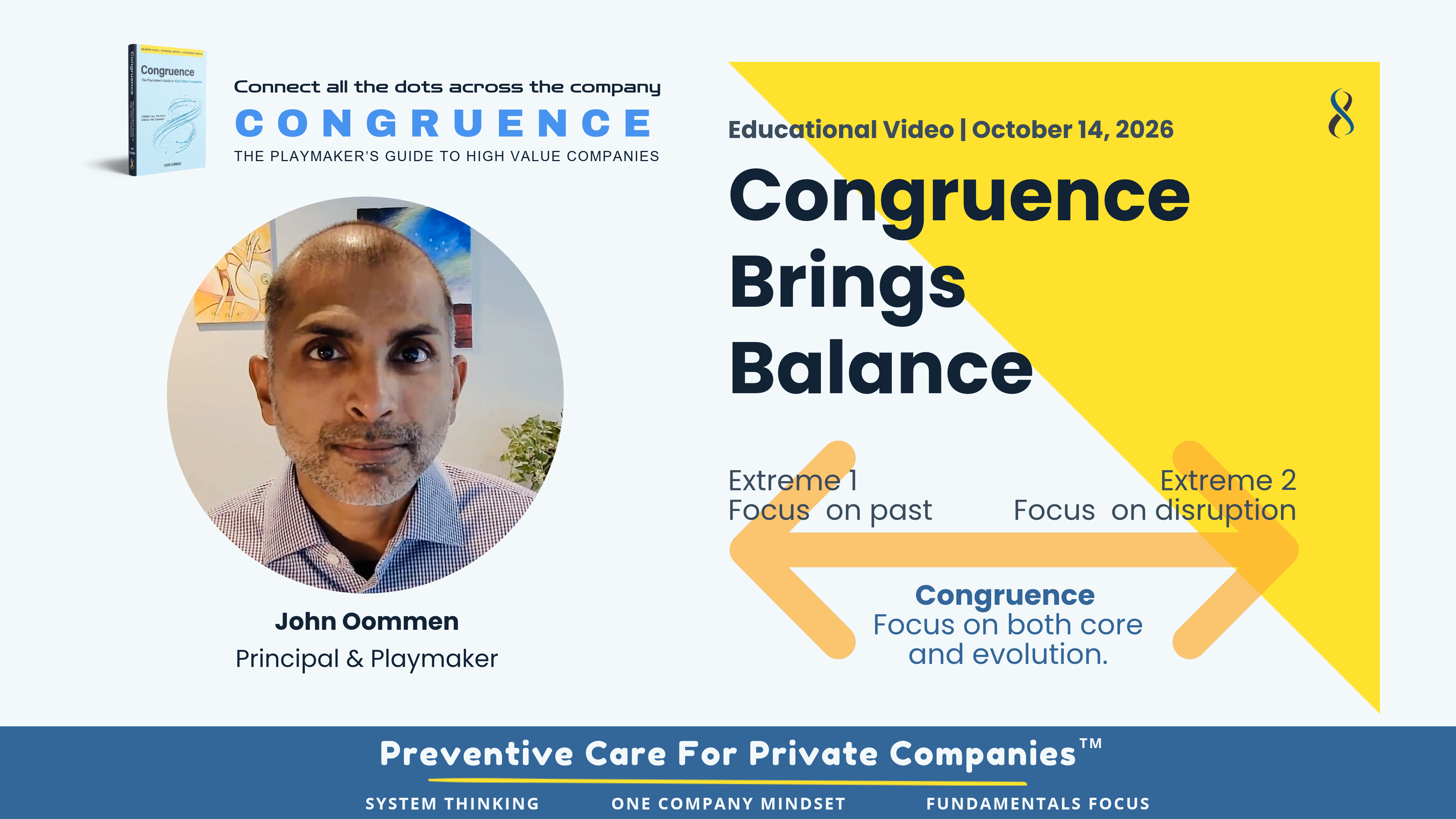
Extremes sell, but truth is always in the middle.
I went through all the popular business-building and improvement ideas over the years and recognized a major gap. As a hands-on problem solver, Congruence wasn't a “book” that I sat down and wrote. It is a solution to a lot of systemic gaps I experienced across dozens of companies. I encourage you to go through Congruence with an objective mindset and compare it to other options out there.
If you categorize each mainstream approach to run and improve companies, they fall into one of two ideological extremes. I have been part of both of these camps several times and have learned a lot through them. But opportunities to improve were also apparent.
This is like guarding a house by watching only the front door or only the back door. To protect and mature a company, we must secure both.
Congruence brings balance. The core of Congruence is Evolution.
Evolution is not relying only on what worked in the past, nor is it chaotic disruption. Evolution builds on a company’s intrinsic core while proactively adapting the company’s reality to all the changes associated with time, scale, and environment.
The middle ground is a concrete Operations Baseline that systemically embraces Macroevolution.
In an economy where the conducive economic assumptions no longer apply and the real value created by individuals and groups is coming under increasing scrutiny, Congruence offers a path to creating unquestionable, intrinsic, and sustainable value.

John Oommen is an electrical engineer turned company-level evolution architect who partners with private company investors and middle-market CEOs to mature and transform portfolio companies. He is the author of Congruence: The Playmaker's Guide to High Value Companies, creator of the underlying proprietary Congruence mindset, model, and method, and pioneer of the Playmaker Capability, which is a must-have value injection mechanism that dovetails purpose, strategy, and operations.
Over more than two decades, John has led company-level transformations, M&A integrations, and operational turnarounds across dozens of mid-market, VC and PE-backed, and Fortune 100 companies, including General Electric, Accenture, Blue Ridge Partners, and Capital One, as well as enterprise clients like Emerson, Ferguson, Cox, Avaya, and Nortek, alongside numerous mid-market companies. He specializes in addressing business-to-business market problems spanning industrial manufacturing, distribution, technology, and tech-enabled services. John holds an MBA from Northwestern University’s Kellogg School of Management, is a certified Six Sigma Black Belt, and is based in Chicago.