
Executive Summary: Total annual sales for only four weight-loss drugs reached ~$26B, which has already surpassed total US egg sales ($17B). Weight loss drugs are expected to reach $100B in the years to come. This presents a stark example of how perceptions of value have mutated. We no longer practice true Capitalism. We practice Duct Tape Economics, which incentivizes an escalating cycle of symptom-solving spending at the expense of intrinsic value-generating businesses.
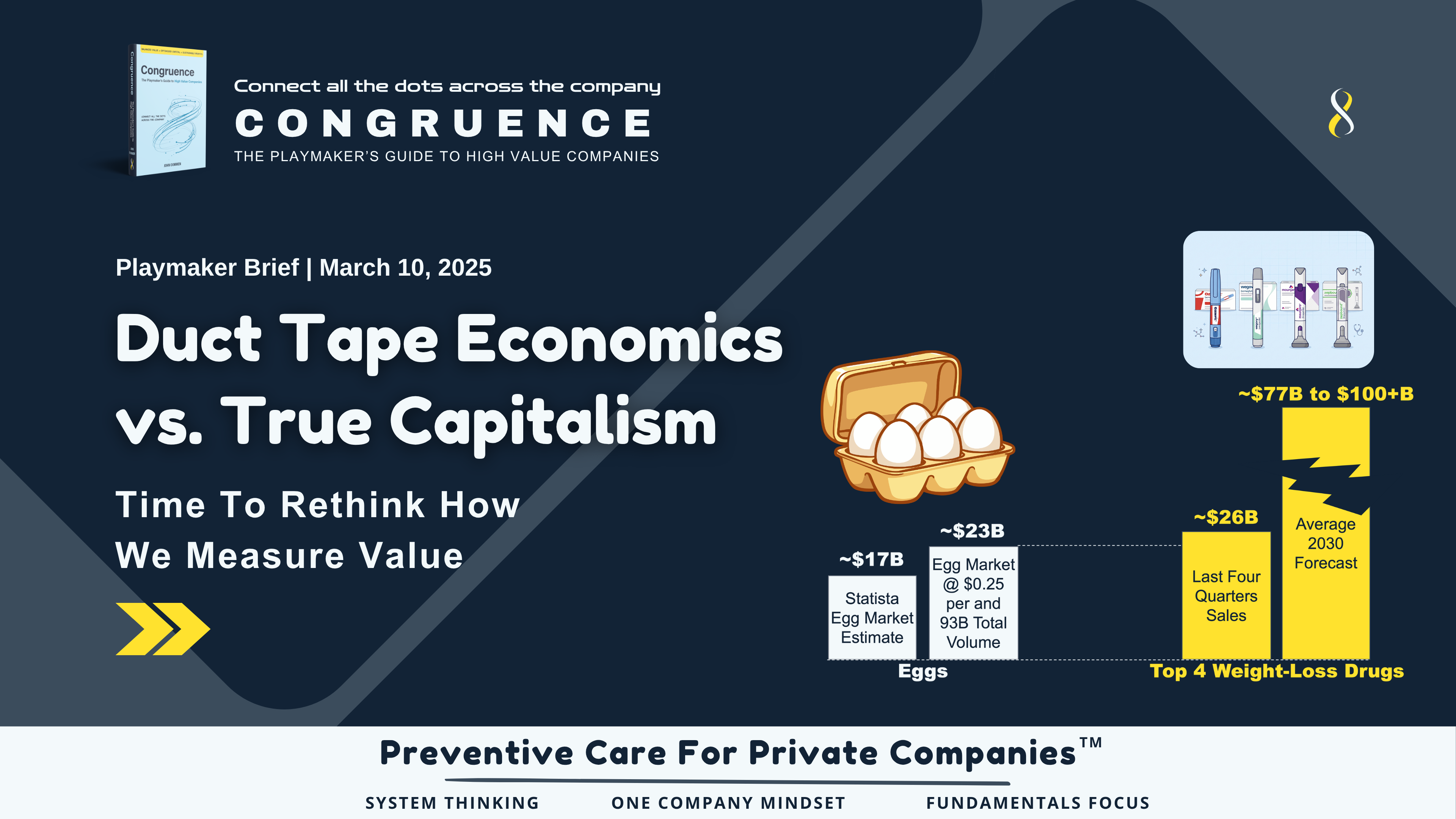
I am a fitness enthusiast and love to eat healthy. Seeing non-stop ads and articles pushing weight-loss drugs on the public makes for a stark contrast with basic staples like eggs. It creates a good showdown between two products on opposite ends of the intrinsic value spectrum.
Eggs, along with milk, are the most basic products consumed by nearly every human across all cultures throughout their lifetime and nearly every single day. Here are some interesting data points about chicken eggs in the United States:
Looking at basic utility, would we not expect the egg industry to command significant total sales revenue? I was surprised to find out how small it really is. At an average baseline price of ~$0.25 per egg, total egg sales in the United States were only $23B (with total US production around 93 billion eggs). Statista reports a total US egg market that is even lower, at $17B.
Now, let’s contrast eggs with a completely different category, weight-loss drugs, to highlight the distorted incentives in our economy. If something feels fundamentally “off” about how we value products, there’s a reason for it.
Weight-loss drugs, which I see marketed as “diabetes medication,” have become a massive market phenomenon. I don’t have any personal experience with the product. I want to focus on two simpler questions.
The stock market has been hyping up total sales of these drugs to exceed $100 billion. Total annual sales in the United States for only four weight-loss drugs already reached ~$26B, which is higher than total US egg sales at a $0.25 per egg price.
Weight-loss drugs are marketed as lifesaving. Let’s ask some rational questions about that claim. A basic problem-solving tool is the Five Whys. Let’s ask some why questions:
We didn’t even get to the fifth Why, but that's the real economy we live in. I call it Duct Tape Economics in Congruence. Mistaking it for Capitalism distracts us from harnessing its true power: efficient value creation.
Duct Tape Economics is “An economic ecosystem that encourages trade that addresses symptoms of problems, as opposed to the root causes of problems.” – Congruence: The Playmaker’s Guide to High Value Companies
If we encourage overconsumption of unhealthy and fattening foods on one side and offer expensive, dependency-creating weight-loss drugs on the other side, we are not really solving a “problem.” We are conveniently addressing a symptom we created through other non-value-creating behaviors.
There is no evidence that weight-loss drugs solve root causes of any problems and may even prove to cause more harm than good over time. The only “problem” they solve is managing the symptoms of other incongruences created by our misconception of “value.” A burger chain might sell an “extra value pack” that includes fries and a soda, but is that truly extra “value” if it causes health problems?
To understand this incentive problem, we have to internalize the difference between Duct Tape Economics and true Capitalism: one incentivizes an escalating cycle of symptom-solving spending, while the other allocates capital to real, intrinsic value. Until we embrace that difference, we cannot complain when intrinsic value-generating businesses struggle at the expense of spurious value creators and symptom solvers.

John Oommen is an electrical engineer turned company-level evolution architect who partners with private company investors and middle-market CEOs to mature and transform portfolio companies. He is the author of Congruence: The Playmaker's Guide to High Value Companies, creator of the underlying proprietary Congruence mindset, model, and method, and pioneer of the Playmaker Capability, which is a must-have value injection mechanism that dovetails purpose, strategy, and operations.
Over more than two decades, John has led company-level transformations, M&A integrations, and operational turnarounds across dozens of mid-market, VC and PE-backed, and Fortune 100 companies, including General Electric, Accenture, Blue Ridge Partners, and Capital One, as well as enterprise clients like Emerson, Ferguson, Cox, Avaya, and Nortek, alongside numerous mid-market companies. He specializes in addressing business-to-business market problems spanning industrial manufacturing, distribution, technology, and tech-enabled services. John holds an MBA from Northwestern University’s Kellogg School of Management, is a certified Six Sigma Black Belt, and is based in Chicago.